

Kitchen Measurement Converter
Instantly convert American recipe measurements: from cups and spoons to grams and millilitres, with different values for each ingredient. And if you want to do without the converter, below you'll find tricks to remember conversions by heart.
Cup size
1 Cup · Flour
16
Tablespoon (tbsp)
48
Teaspoon (tsp)
240
Millilitres
120
Grams
4.23
Ounces (oz)
Trick: Flour weighs half as much as water: one cup is about 120g and one tablespoon 8g. To convert from grams to cups, divide by 120.
How many grams are in a cup?
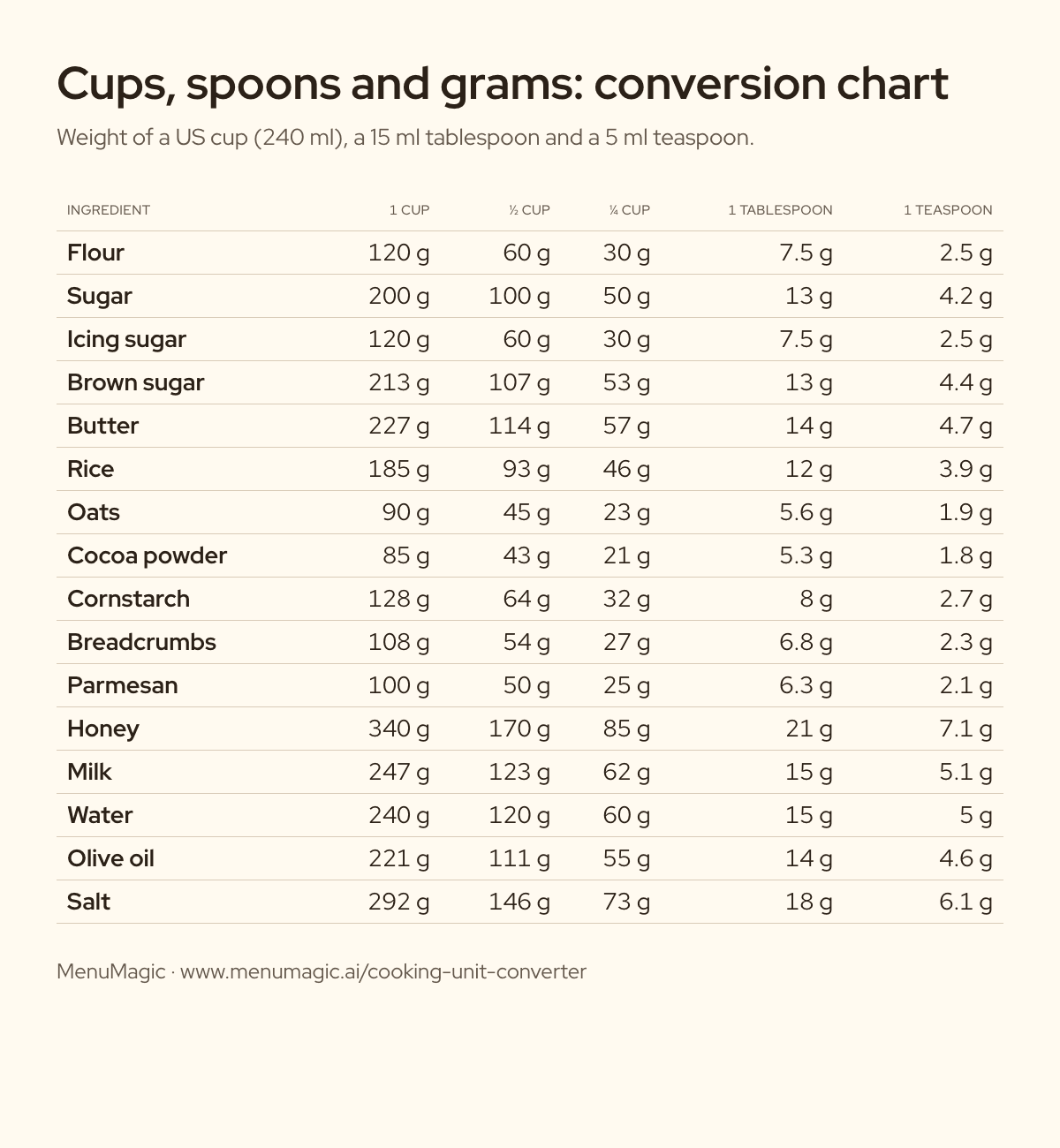
A US cup is equivalent to 240 ml, but the weight in grams changes with the density of the ingredient: a cup of flour weighs about 120g, one of sugar 200g, and one of honey 340g.
American recipes measure ingredients by volume, European ones by weight. To convert correctly, you need the density of each ingredient: this converter does the calculation for you.
| Ingredient | 1 cup | ½ cup | ¼ cup | 1 tablespoon | 1 teaspoon | 100g in cups |
|---|---|---|---|---|---|---|
| Flour | 120 g | 60 g | 30 g | 7.5 g | 2.5 g | ¾ |
| Sugar | 200 g | 100 g | 50 g | 13 g | 4.2 g | ½ |
| Icing sugar | 120 g | 60 g | 30 g | 7.5 g | 2.5 g | ¾ |
| Brown sugar | 213 g | 107 g | 53 g | 13 g | 4.4 g | ½ |
| Butter | 227 g | 114 g | 57 g | 14 g | 4.7 g | ½ |
| Rice | 185 g | 93 g | 46 g | 12 g | 3.9 g | ½ |
| Oats | 90 g | 45 g | 23 g | 5.6 g | 1.9 g | 1 |
| Cocoa powder | 85 g | 43 g | 21 g | 5.3 g | 1.8 g | 1 ¼ |
| Cornstarch | 128 g | 64 g | 32 g | 8 g | 2.7 g | ¾ |
| Breadcrumbs | 108 g | 54 g | 27 g | 6.8 g | 2.3 g | 1 |
| Parmesan | 100 g | 50 g | 25 g | 6.3 g | 2.1 g | 1 |
| Honey | 340 g | 170 g | 85 g | 21 g | 7.1 g | ⅓ |
| Milk | 247 g | 123 g | 62 g | 15 g | 5.1 g | ⅓ |
| Water | 240 g | 120 g | 60 g | 15 g | 5 g | ½ |
| Olive oil | 221 g | 111 g | 55 g | 14 g | 4.6 g | ½ |
| Salt | 292 g | 146 g | 73 g | 18 g | 6.1 g | ⅓ |
How to remember conversions mentally
Six numbers and three comparisons are enough to convert almost all recipes without looking up a chart. Learn them once, and the converter will only be needed for rare cases.
The spoon scale: 3, 16, 240
3 teaspoons make 1 tablespoon (15ml) and 16 tablespoons make 1 cup (240ml). These three numbers are enough for all volume conversions.
Water is the measure: 1ml = 1g
Water, milk, broth and juices weigh the same as their volume. A cup is 240g, a tablespoon 15g, a teaspoon 5g.
Flour half, butter almost, honey one and a half
Compared to water, flour weighs half (120g per cup), butter almost the same (225g), and honey one and a half times (340g).
Sugar is 200
200g per cup, 12g per tablespoon, 4g per teaspoon: a sachet from a cafe is your reference teaspoon.
An ounce is '30 minus a bit'
1 oz is 28g: count 30g per ounce and subtract 5%. 100g is three and a half ounces, 1kg is 35 ounces.
From grams to cups: divide by the weight of one cup
100g of flour divided by 120 is 0.83: three-quarters of a cup plus one tablespoon. 100g of sugar divided by 200 is exactly half a cup.
FAQ on kitchen conversions
How many cups is 100g of flour?
100g of flour is 0.83 cups, which is just over three-quarters of a cup: a US cup measures 240ml and a cup of flour weighs 120g. The result changes with the ingredient, because density changes: 100g of sugar is 0.5 cups and 100g of honey is 0.29 cups.
How many tablespoons is 25ml?
25ml is 1.67 tablespoons, because one tablespoon holds 15ml. If you need a precise measurement, 25ml is exactly 5 teaspoons of 5ml each, which is about one-tenth of a 240ml cup. Since these are two volume measurements, the conversion applies to any ingredient.
How many grams is half a teaspoon?
It depends on the ingredient, because half a teaspoon is a volume (2.5 ml) and not a weight. Half a teaspoon of flour weighs 1.25g, sugar 2.08g, salt 3.04g, and honey 3.54g. Water is the simplest case: 2.5ml of water weighs 2.5g.
How do you convert grams to tablespoons?
Divide the grams by the weight of one tablespoon of that ingredient. A tablespoon holds 15ml, which is one-sixteenth of a 240ml cup: a tablespoon of flour weighs 7.5g, sugar 12.5g, butter 14.19g, and honey 21.25g. So 50g of flour is 6.67 tablespoons, while 50g of sugar is exactly 4 tablespoons.
Why does a cup of flour weigh less than a cup of honey?
Because a cup always measures the same volume, 240 ml, while weight depends on the ingredient's density. Flour is light and airy: 240 ml weighs 120 g, which is 0.5 g per millilitre. Honey is dense and viscous: the same 240 ml weighs 340 g, about 1.42 g per millilitre, almost triple that of flour. Water is in the middle, with 240 g per cup and exactly 1 g per millilitre. This is why a conversion based solely on volume, without choosing the ingredient, almost always gives an incorrect result.
What's the difference between an American cup and a metric cup?
The American cup (US cup) measures 240 ml, while the metric cup used in Australia, Canada, and many European recipes measures 250 ml: the difference is 4%, which is less than a tablespoon. For most recipes, you can ignore it; for desserts with many cups, choose the right measurement with the selector at the top of the page.
 MenuMagic
Recipes
Vegan recipes
Vegetarian recipes
Keto recipes
Protein recipes
Lactose-free recipes
Gluten-free recipes
Low glycaemic index recipes
Resources
Blog
Recipe Generator
Leftovers Recipe Generator
Printable Shopping List
Kitchen Measurement Converter
Calorie Calculator
Seasonal Fruits and Vegetables
Our other apps
WindNow


© 2026 MenuMagic.
All rights reserved.