

The 5-3-10-5 Food Shop Method Explained (With a Week’s Shop)
Last updated: 4 October 2026
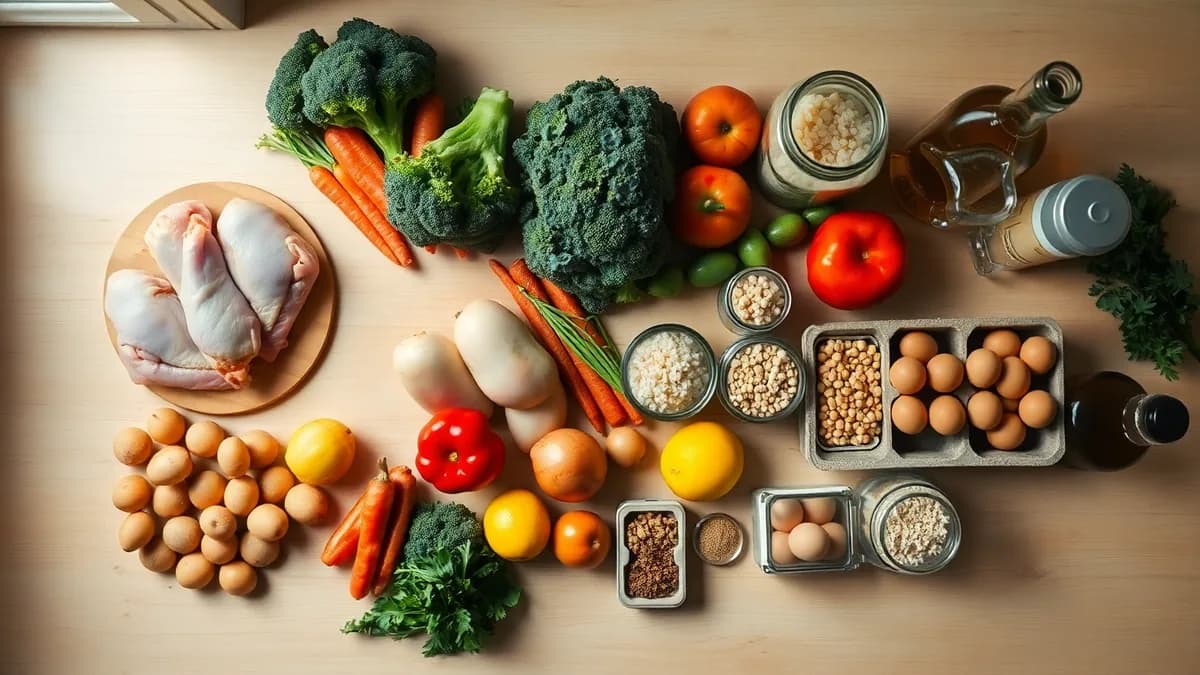
The 5-3-10-5 food shop method (you’ll also see it written 5.3.10.5 or 5:3:10:5) comes from Hari Beavis, a UK creator who posts her weekly shops on TikTok . The whole idea fits on the back of a receipt: each week you buy 5 proteins, 3 carbohydrates, 10 fruits and vegetables, and 5 flavour builders. That is 23 items, and she reckons they feed two people for breakfast, lunch and dinner for about £40 to £50.
The numbers aren’t really the point. The point is the order you do things in. Instead of choosing seven recipes first and buying a one-off ingredient for each of them, you buy a small, sensible set of ingredients and choose the recipes afterwards, from what is already in the kitchen.
What is the 5-3-10-5 food shop method?
Beavis describes it as shopping for possibilities rather than for a fixed list of recipes. Your fridge, freezer and cupboard become a small supermarket of your own, and dinner is whatever you can make from what is in it. The four numbers are there to stop the small supermarket turning into a big, random one.
- 5 proteins. Chicken thighs, mince, eggs, tinned fish, a block of tofu, a tin of chickpeas. Anything that can be the middle of a plate.
- 3 carbohydrates. Potatoes, rice, pasta, bread, oats, couscous. Three is tight on purpose.
- 10 fruits and vegetables. The big allowance. Fresh, frozen and tinned all count.
- 5 flavour builders. The things that make the same chicken and potatoes taste different on Monday and Thursday. Stock cubes, pesto, soy sauce, a curry paste, a lemon, garlic.
Each number counts distinct items, not quantities. Two packs of chicken thighs is still one protein. A 2.5 kg bag of potatoes is one carb. How much of each you buy depends on who you feed and how hungry they are.
Her own spoken example shows the whole idea: chicken thighs, potatoes, a few veg and some flavour builders become a chicken pot pie, a tray bake, or a soup. Nothing clever, just different combinations of one shop.
What counts as a flavour builder?
This is the group people ask about most, because the other three are obvious. A flavour builder is anything you add in small amounts that changes the taste of a whole dish. A jar, a bottle, a tube, a bulb.
The usual suspects are curry paste, soy sauce, tomato purée, chicken stock cubes, garlic, pesto, lemons, a tin of coconut milk, a wedge of parmesan and chilli flakes. Dried herbs and spices count too. Salt, pepper and cooking oil don’t need counting. Those are just there.
Two things to know. Most flavour builders last for weeks, so you don’t rebuy five every time; you replace what has run out and add one new thing. By week three the five are more likely to be garlic, lemons, a jar of harissa, stock cubes and the parmesan you forgot last time. And a flavour builder only earns its place if it goes with several things. Harissa goes on chicken, chickpeas, roast veg and eggs. A jar of hoisin goes on duck. Buy the harissa.
A week’s shop for two, with rough prices
Her full example shops are in her paid PDF, so this is our own list, not hers. Prices are rough mid-range UK supermarket prices for autumn 2026, so treat them as a guide rather than a receipt.
Proteins (5)
- Chicken thighs, 1 kg, £4.50
- Beef mince, 500 g, £3.75
- 12 eggs, £2.80
- Tinned tuna, 3-pack, £3.00
- Tinned chickpeas, 2 tins, £1.20
Carbohydrates (3)
- Potatoes, 2.5 kg, £1.50
- Basmati rice, 1 kg, £2.00
- Wholemeal loaf, £1.20
Fruit and veg (10)
- Onions, £0.90
- Carrots, £0.60
- Broccoli, £0.80
- Red peppers, 3, £1.60
- Mushrooms, £1.10
- Bag of spinach, £1.20
- Tinned tomatoes, 2 tins, £1.00
- Frozen peas, £1.20
- Bananas, £1.00
- Apples, 6, £1.80
Flavour builders (5)
- Garlic, £0.50
- Lemons, 2, £0.70
- Chicken stock cubes, £1.40
- Jar of curry paste, £2.00
- Soy sauce, £1.50
That comes to about £41, which lands where Beavis says it should. Milk, butter, oil, tea and the usual aren’t in it. If you’re starting from an empty cupboard, add a tenner.
What those 23 items turn into
Writing the shop is the easy part. The habit that makes it work is deciding the first two or three dinners before anything goes in the fridge, because the spinach and the mushrooms go off first and the potatoes can wait a fortnight.
This is how a week could go with that list:
- Monday: chicken thighs roasted with potatoes, peppers and onions, lemon and garlic over the top. Half the chicken goes back in the fridge.
- Tuesday: mince cooked down with onion, carrot, tinned tomatoes and a stock cube. Half over rice, the other half in the freezer.
- Wednesday: leftover chicken, curry paste, the spinach, a tin of chickpeas, rice. Twenty minutes.
- Thursday: the fridge looks thin. Egg fried rice with peas, soy sauce, mushrooms and whatever pepper is left.
- Friday: the frozen mince comes out. Cottage pie with the rest of the potatoes, broccoli on the side.
- Weekend: tuna and chickpea salad with lemon for lunches, eggs on toast for breakfasts, bananas and apples on the way out of the door.
Every dinner in that week is a recipe, but none of them was chosen before the shop. On Wednesday you open the fridge, see chicken, spinach and curry paste, and pick something that uses all three.
Where it goes wrong
Ten fruits and vegetables for two people is a lot of produce if you aren’t careful. Buy ten fresh things in week one and there is a fair chance a courgette and half a cabbage end up in the bin. The fix is boring: count frozen and tinned towards the ten. Frozen peas, frozen spinach, tinned tomatoes and tinned sweetcorn are all vegetables, they don’t rot, and they take the pressure off the salad drawer.
Three carbs is the other squeeze. If you want potatoes, rice, pasta and bread, that’s four, and one has to go. For most people bread is the easiest one to drop, with potatoes picking up the slack.
Five proteins is generous for two. Some weeks four will do and nobody misses the fifth. Treat the numbers as a shape to aim at. The point is that you walk in with a count and walk out with something close to it, rather than with whatever the end-of-aisle display was pushing.
5-3-10-5 vs 5-to-1 vs 3-3-3
If you’ve read our guide to the 5-to-1 method (5-4-3-2-1) , the differences are easy to spot.
| 5-to-1 | 3-3-3 | 5-3-10-5 | |
|---|---|---|---|
| Formula | 5 veg, 4 fruit, 3 proteins, 2 carbs, 1 treat | 3 carbs, 3 proteins, 3 fats | 5 proteins, 3 carbs, 10 fruit and veg, 5 flavour builders |
| Items | 15 | 9 | 23 |
| Built around | Produce | The bare minimum | Protein and flavour |
| Treat | One, planned | None | None, though a jar of something good does some of that work |
5-to-1 is produce-led: nine of its fifteen items are fruit and veg, and it has no flavour group at all. That’s why people who try it end up with five vegetables that all taste like the same steamed vegetables. 5-3-10-5 fixes that with the five flavour builders and two more proteins, at the cost of eight extra items and no planned treat. The 3-3-3 method is a much smaller shop, nine items, built for one person or a tight week.
On cost, 5-3-10-5 is not cheaper in the first week. Twenty-three items cost more than fifteen, and the jars add up. From week two it often is cheaper, because the stock cubes, the soy sauce and the rice are still there, and your five flavour builders become two. Our side-by-side of the 3-2-1, 3-3-3, 5-to-1 and 6-to-1 rules goes into which size suits which household.
If you don’t eat meat
The five proteins become tofu, eggs, chickpeas, lentils, halloumi, tinned beans, tempeh. Most of these keep for months, so it’s easier, if anything. Spend one flavour builder on something with real punch, such as miso or smoked paprika, to make up for the browned-meat flavour you lose.
Getting the meals out of the shop
The method tells you what to buy. It doesn’t tell you what to cook on Thursday, which is the evening most people order a takeaway. A note on the fridge with the first three dinners written down does most of the work. For the nights the note doesn’t cover, MenuMagic’s free leftovers recipe generator does the Wednesday job: type in what is left in the fridge and it writes recipes from those ingredients. If you’d rather plan the whole week, MenuMagic builds the meals and the matching shopping list with quantities; it has a Plan Rule for the 5-to-1 method, and you can type the 5-3-10-5 shape into your rules in your own words.
Put this method to work
Generate a week of recipes from what's already in your fridge, or grab the printable grocery list.
FAQ: what is the 5-3-10-5 food shop method?
A weekly shopping formula from UK creator Hari Beavis: 5 proteins, 3 carbohydrates, 10 fruits and vegetables and 5 flavour builders, 23 items in total. You shop for possibilities rather than for fixed recipes, then pick the meals from a stocked kitchen. She frames it as feeding two people for roughly £40 to £50 a week.
FAQ: what counts as a flavour builder?
Anything used in small amounts that changes how a dish tastes: stock cubes, curry paste, soy sauce, pesto, garlic, lemons, tomato purée, coconut milk, spices, a hard cheese. Salt, pepper and cooking oil are usually left out of the count. Most of these last for weeks, so later shops need fewer of them.
FAQ: is 5-3-10-5 cheaper than 5-to-1?
Not in week one: 23 items cost more than 15. From week two the flavour builders and dry carbs are still in the cupboard, so the shop shrinks and the two methods cost about the same. 5-3-10-5 spends more on protein and flavour, 5-to-1 more on produce.
FAQ: is it 5-3-10-5 or 5-3-5-10?
5-3-10-5: proteins, carbohydrates, fruit and veg, flavour builders. People sometimes swap the last two numbers in comments, but the ten is the produce.
Put this method to work
Generate a week of recipes from what's already in your fridge, or grab the printable grocery list.
More posts
 MenuMagic
Recipes
Vegan recipes
Vegetarian recipes
Keto recipes
Protein recipes
Lactose-free recipes
Gluten-free recipes
Low glycaemic index recipes
Resources
Blog
Recipe Generator
Leftovers Recipe Generator
Printable Shopping List
Kitchen Measurement Converter
Calorie Calculator
Seasonal Fruits and Vegetables
Our other apps
WindNow
Our other apps
WindNow


© 2026 MenuMagic.
All rights reserved.